Why medication routines drift even with good intentions
It often starts with a small pause at the sink: the bottle is open, a pill is in your hand, and you can’t tell if this is “today’s” dose or the one you meant to take ten minutes ago. Nothing dramatic changed—you’re still careful. But the day has more moving parts than your medication plan does: an early meeting, a late dinner, a child who woke up sick, a different bottle because the pharmacy switched manufacturers.
Routines drift because they rely on cues that aren’t stable. “After breakfast” works until breakfast becomes coffee in the car. “Before bed” works until you fall asleep on the couch. Even when you never intend to skip, the system quietly re-optimizes around whatever is loudest—fatigue, urgency, interruptions—so the dose becomes something you fit in, not something you can clearly verify. Over time, the signs show up as leftover pills, refills that feel too early or too late, and more moments of uneasy guessing.
Where mix-ups start: names, lookalikes, and timing
The mix-up usually doesn’t feel like a mistake at first—it feels like a normal, slightly rushed morning. Two bottles land on the counter, both with similar white tablets, and the labels blur into a familiar pattern of long names and small print. If you’re taking a prescription plus a supplement, or you’ve had a recent switch to a “new” generic, your brain may lean on shape and color instead of the actual name. That’s when “close enough” becomes the default, especially if the bottles live in the same spot.
Timing adds another layer of confusion because instructions can sound simple while your day isn’t. “Twice daily” may drift into “once with breakfast, once whenever I remember,” and “with food” can get interpreted as “after I eat something,” even if meals slide later. When a dose moves by hours, it can collide with the next one, and suddenly the question isn’t just what you took—it’s when it still counts as the same dose.
Choosing a system that matches your daily friction
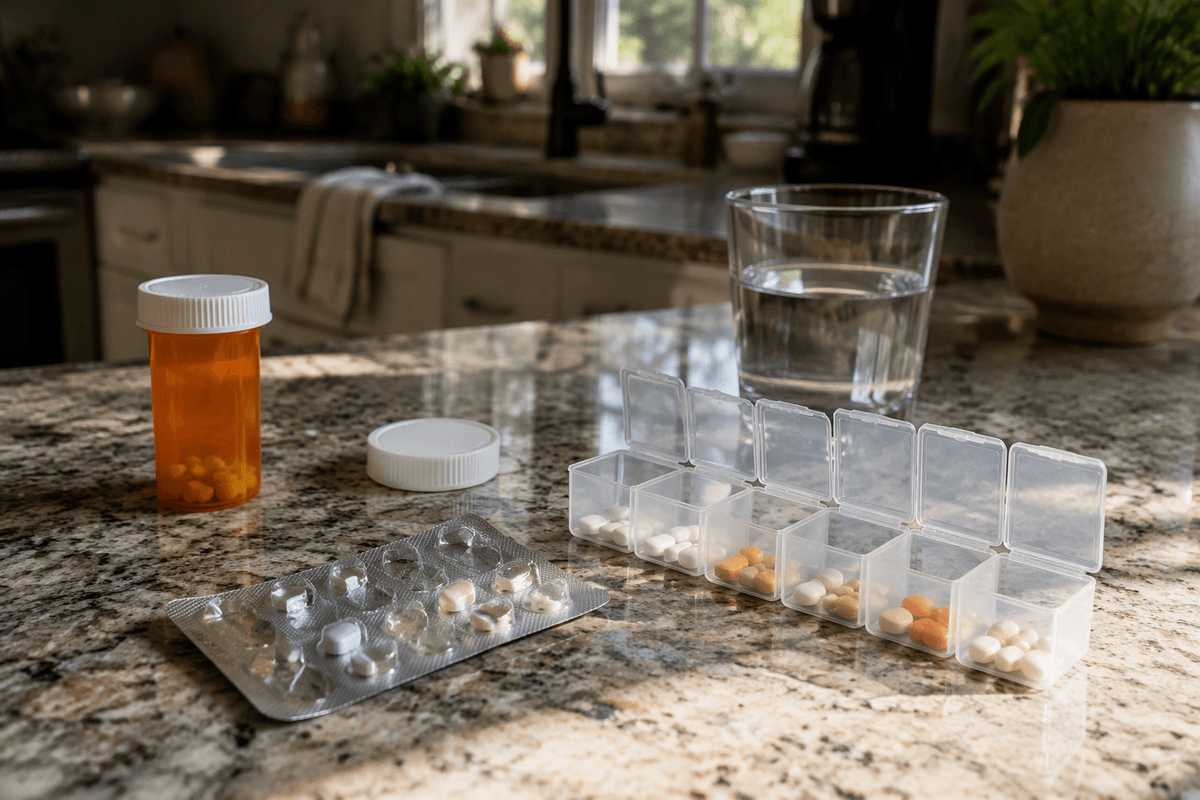
By midweek, the counter can start to look like a tiny staging area: a bottle you keep “just in case,” a blister pack you meant to finish first, a weekly box that’s half-used because yesterday ran long. The mistake many people make is assuming the most “organized” setup is automatically the safest. But the safest system is usually the one that still works when you’re tired, interrupted, or doing it one-handed while someone else needs you.
If your friction point is memory (“did I take it?”), a checkable record tends to matter more than perfect timing. If your friction point is switching locations (work bag, bedside, kitchen), duplicates and loose pills can quietly create competing “truths.” And if your friction point is variable meals or shifts, anchoring everything to breakfast or bedtime may create more uncertainty than it solves. A system is a match when it reduces guessing on your worst days, not your best ones.
When a helpful organizer unexpectedly increases risk
A weekly pill box can feel like relief the first time you snap the lids shut—proof that you’re “set” for the next few days. But a small oddity often shows up later: a Tuesday slot that’s empty too soon, or a Friday slot that still has one tablet rattling around. The organizer starts to look like the problem, when it’s really exposing how often doses get moved around by real life.
Organizers can increase risk when they erase the original label at the exact moment you need it. Once pills are out of their bottles, lookalikes become easier to confuse, and a last-minute change—an antibiotic added, a dose increased, a “new” generic that replaces the old one—can linger in the box even after you’ve updated everything else. And if more than one person fills it, or you refill it while distracted, the mistake gets duplicated seven times before it’s noticed.
Building reminders that survive weekends and disruptions

Saturday has a way of breaking the “I always take it at 8” story. You wake up later, eat whenever, and the usual landmarks—commute, lunch break, getting home—aren’t there to quietly confirm what you’ve already done. That’s when memory starts filling gaps with confidence. If you take a dose a few hours late, you may still feel like you took it “this morning,” even as it drifts closer to the next scheduled time and turns into a second round of uncertainty.
Reminders tend to fail when they depend on a single cue. An alarm can be silenced in the middle of a phone call and never revisited; a sticky note can blend into the rest of the counter clutter. The reminders that hold up better are the ones that leave a trace you can check later—something that answers “did I take it?” without requiring you to remember how distracted you were. Even then, travel days and disruptions can create competing records, especially if you keep backup doses in multiple places.
Storage and transport habits that prevent silent mistakes
You notice it when you’re packing: the “backup” bottle in your bag has a different label than the one on the kitchen counter, and a couple of loose tablets have collected in the bottom pocket like spare change. It can feel reassuring—more coverage, less chance of missing a dose. But duplicates in multiple places can quietly create two competing stories about what you’ve taken, especially after a rushed morning or a late-night catch-up dose.
Silent mistakes tend to start with containers, not intentions. Loose pills in a keychain tube or unmarked baggies may look tidy, but they strip away the one thing that settles arguments later: the label and instructions. Mixing old and new refills in the same bottle can blur the count, so “leftover pills” stops meaning anything. Even storage spots matter—heat, humidity, and a glove compartment that swings from hot to cold can make a routine feel intact while the details drift in the background.
Refills, medication lists, and catching problems early
The first clue is usually a simple count that doesn’t match your story. You pick up a refill and realize you still have a week left, or you go to pour the next dose and the bottle is lighter than it should be. It can feel like the pharmacy shorted you, or that you “must have missed a few,” but often it’s just routine drift made visible—extra catch-up doses on chaotic days, a weekend schedule that slid, a second bottle living in a bag, or a strength change that didn’t fully replace the old one.
A medication list can work like a calm tie-breaker when memory gets fuzzy—especially if it includes the exact name on the label, the dose, what it’s for, and when you last changed anything. Without that, refills become guesswork, and small discrepancies get normalized until they’re hard to untangle. If the pattern continues—early refills, scattered bottles, or more “did I take it?” moments—it may be a signal that your tracking method isn’t surviving real life, not that you’re suddenly careless.








![10 Best Investments for Roth IRA Accounts [Tax-Smart Growth]](static/image/2026/09/01/294b8a88-86c3-4ea2-afdd-320fc305e84d.png)