Toronto stays: why neighborhood choice matters
The first time I tried to “just book something central” in Toronto, the map made everything look equally close—until we realized a 20-minute distance can turn into a 45-minute transit chain once you factor in streetcars, transfers, and late-night frequency.
Neighborhood choice matters here because it quietly controls your whole trip rhythm: how often you’ll pop back to the hotel, whether dinner feels like a quick walk or a planned outing, and how much street noise you’ll tolerate at 1 a.m. The wrong base isn’t unsafe so much as inconvenient—too quiet and you end up spending on rides, too lively and sleep gets choppy, too “tourist-central” and prices climb without better food. Pick the right area once, and the city feels easy; pick wrong, and you’ll feel like you’re commuting through your own vacation.
How to pick your base fast

The fastest way we stopped second-guessing Toronto neighborhoods was by admitting we weren’t choosing “the best area”—we were choosing where we’d want to end up at 10:30 p.m. after dinner, and where we’d want to start at 8:30 a.m. without needing a 20-minute transit warm-up. If you and your partner expect midday breaks (drop bags, reset, change for dinner), staying truly central beats a “cool” pocket that’s technically close but functionally separated by streetcar time and transfers.
I’d make the decision in three filters, in this order. First: transit friction—aim for a short walk to Line 1 or a frequent streetcar route; it’s not about distance, it’s about how often you’ll wait. Second: night sound tolerance—if you’re light sleepers, avoid being directly on nightlife spines (you’ll pay the price at 1 a.m. even on midweek nights). Third: food-by-foot—check whether you can walk to a handful of places you’d actually eat, because “great restaurants” don’t help if they all require a ride. Once those three feel right, price differences between nearby areas usually reflect noise level and convenience, not “safety.”
Central picks: Downtown, Waterfront, Yorkville
We almost booked right on Yonge-Dundas because it looked “as central as central gets,” but standing there at night made the decision feel less abstract: it’s busy, bright, and convenient, yet it can read chaotic if you’re crowd-sensitive and it’s rarely quiet. Downtown works best when you want to be able to walk back after dinner, hit multiple sights without planning, and use Line 1 as your default—just be picky about the exact micro-location (one block can shift from calm to sirens-and-bars). If you’re mid-range budgeting, expect to pay more for that convenience, and don’t assume higher price equals better sleep.
The Waterfront is the tempting “nice views” choice, and it does feel calmer when you’re done with the day—but it can be a little sterile if you want spontaneous food hopping. Transit is fine when you’re close to Union Station or a reliable streetcar, but the walk back can feel long in bad weather, and some pockets get surprisingly quiet after office hours (great for rest, less great if you like energy right outside).
Yorkville is the “polished and easy” option: quieter nights, strong restaurant density, and a straightforward Line 1/Line 2 connection nearby. The catch is cost—hotels and even casual meals skew pricier—and it can feel more boutique-shopping than city-grit. Choose it if you value calm and convenience over maximizing value per dollar.
Culture picks: Kensington, Queen West, The Annex
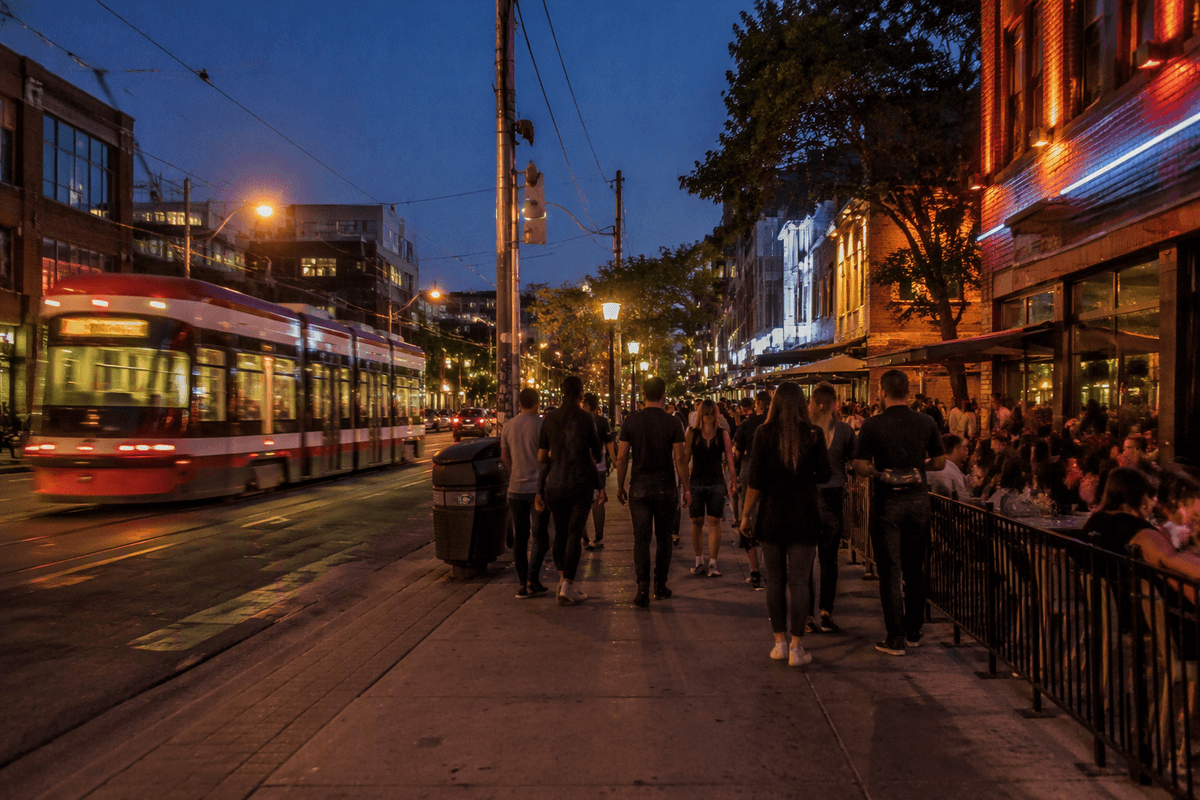
One afternoon we ducked into Kensington for “a quick snack” and surfaced two hours later with coffee, empanadas, and the feeling that we’d accidentally spent our museum time budget on people-watching. Kensington Market is ideal if you want your neighborhood to double as an activity—food stalls, thrift, small patios—but it’s not the spot if you crave predictable calm. Nights can be noisy on weekends, and some blocks feel a little scruffier than the polished parts of downtown; not unsafe, just a vibe shift that can bother first-timers who equate “quiet” with “comfortable.” Transit is workable (streetcars, short hops), but you’ll walk more than you think.
Queen West (and the Ossington edge) is where we found the easiest “pick a direction and eat” evenings—great bars, modern restaurants, and that continuous street life that makes a 9:30 p.m. stroll feel normal. The friction is sleep: if your hotel is too close to the main strip, bass and late patios can leak into your room, even midweek. It’s also a little less plug-and-play for subway access than Line 1 areas, so short streetcar rides become your default.
The Annex is the calmer culture pick: near the ROM/U of T orbit, solid food on Bloor, and a clean Line 1/Line 2 connection that keeps your days efficient. It can feel residential at night (good for rest, less for “step outside into buzz”), and mid-range hotels are thinner here—sometimes you’re choosing between pricier boutique stays or simpler options.
Local picks: Leslieville, Riverdale, The Beaches
We kept circling the east end because the photos looked calmer—and then we remembered we weren’t renting a car. That’s the moment these “local” neighborhoods reveal their real personality: they’re lovely when you’re in them, but the commute back after a late dinner can feel longer than the map suggests, especially if you’re relying on streetcars and timing transfers instead of hopping on Line 1.
Leslieville is the easiest east-side base if you want café mornings, low-key restaurants, and streets that feel lived-in rather than staged for visitors. It works best for couples who like an earlier pace and don’t need to be downtown every afternoon. The catch is transit: you’ll be leaning on the Queen/King streetcars or a quick ride to a subway station, and a “simple” trip can become slow if service bunches or it’s raining and you’re done walking.
Riverdale (especially near Danforth) is the practical pick: you get a more residential feel without giving up the subway, so your days don’t get eaten by streetcar time. It’s less immediate buzz outside your door than Queen West, but the trade is steadier sleep and easier returns. The Beaches is the most relaxing—boardwalk energy, quieter nights, great for morning walks—but it’s the furthest from core sights, and you’ll feel that distance every time you decide to “just pop back” before dinner.
Final shortlist: choose one neighborhood confidently
The way we finally booked was by picking the one thing we refused to fight each day: transit, noise, or price. If you want the simplest 4–5 nights with minimal planning, choose Downtown (closest-to-everything, but crowdier and louder) or Yorkville (calmer nights, but you’ll pay for it). If you like a reset-at-night feeling, Waterfront can work—just accept that “quickly popping back” sometimes turns into a longer walk in wind or rain.
If food and street life are the point, pick Queen West (best evening energy, most sleep risk) or Kensington (most character, least predictable). If you want a steadier middle, The Annex is the easiest compromise (excellent subway access, quieter vibe). Go east only if you’re okay with slower returns: Riverdale/Danforth stays efficient via subway; Leslieville is sweeter but more streetcar-dependent; The Beaches is restorative, but it’s a commitment. Once you choose, book the best micro-location near frequent transit—Toronto rewards precision more than perfection.






![10 Best Investments for Roth IRA Accounts [Tax-Smart Growth]](static/image/2026/09/01/294b8a88-86c3-4ea2-afdd-320fc305e84d.png)